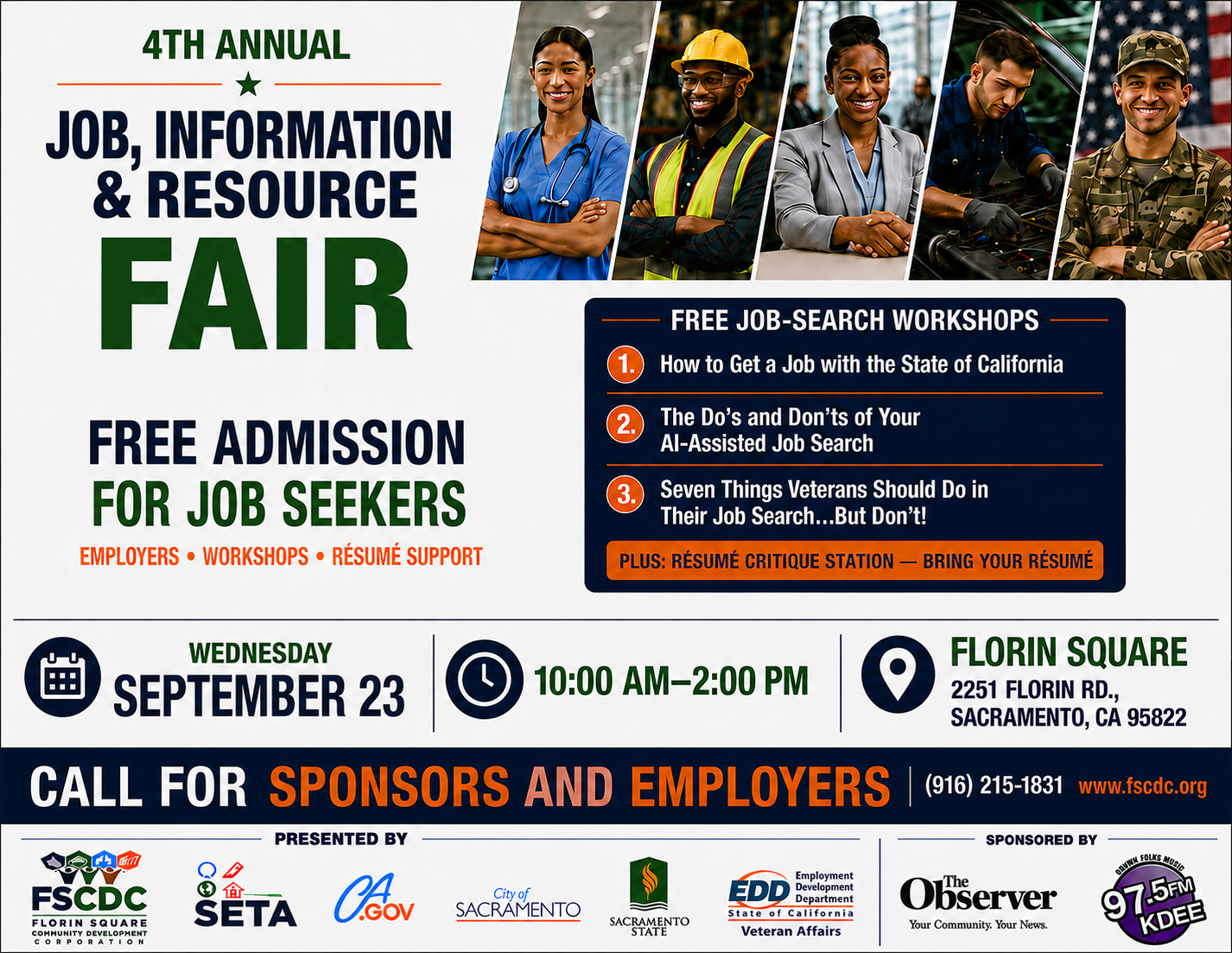





Florin Square Community Development Corporation presents

4th Annual
Job, Information &
Resource Fair

Connect directly with employers, explore career opportunities, and meet organizations offering practical community resources.

Free admission for job seekers • Open to the community

Official 4th Annual Job, Information and Resource Fair campaign flyer showing a diverse workforce
Official 2026 event campaign
📅 WHEN
🕙 TIME10:00 AM–2:00 PM
📍 WHEREFlorin Square, 2251 Florin Road, Sacramento, CA 95822
🎟️ ADMISSIONFree for Job Seekers

More than a job fair

Three Practical Job-Search Workshops

Build stronger strategies, avoid costly mistakes, and leave with information you can put to work immediately.

WORKSHOP 01

How to Get a Job with the State of California

Learn how to find State opportunities, understand the application process, and take the right steps toward becoming a competitive candidate.

WORKSHOP 02

The Do’s and Don’ts of Your AI-Assisted Job Search

Use AI to strengthen your search without sacrificing accuracy, privacy, authenticity, or your own professional voice.

WORKSHOP 03

Seven Things Veterans Should Do in Their Job Search…But Don’t!

Practical guidance to help veterans translate military experience, uncover opportunities, and avoid commonly missed job-search steps.

Updated as organizations confirm

Scheduled Employers

Check back regularly. New employers and hiring information will be added leading up to the fair.

Sacramento Employment and Training Agency

Workforce development, employment services, and career resources.

Confirmed Exhibitor

SMUD

Explore career opportunities with Sacramento’s community-owned electric utility.

Confirmed Exhibitor

State of California

Learn about State careers, hiring pathways, and public-service opportunities.

Confirmed Exhibitor

California Employment Development Department

Employment services, job-search assistance, and resources for California workers.

Confirmed Exhibitor

Sacramento State

Explore employment opportunities, career pathways, and ways to serve the Sacramento State community.

Confirmed Exhibitor

Sacramento County Probation Department

Explore careers in probation services, public safety, administration, and community supervision.

Confirmed Exhibitor

San Francisco Sheriff’s Office

Explore sworn and civilian public-safety careers, professional development, and opportunities to serve San Francisco communities.

Confirmed Exhibitor

Now recruiting employers and resource providers

Employers/Exhibitors Register Here.

Meet motivated candidates, promote current opportunities, and connect your organization with the South Sacramento community.

Employer and resource-provider applicationComplete the Cognito Registration FormThe application opens in a new window.

Job seekers and applicants

Applicants – Register Here.

Sign in before the fair so FSCDC can better understand who plans to attend and provide useful event information.

Complete Applicant Sign-In

Arrive prepared

Success Tips for Job Seekers

A little preparation can turn a brief introduction into a real employment lead.

01

Bring several résumés

Plan for at least 10–15 printed copies, even if you have already applied online.

02

Dress ready to interview

First impressions matter. Choose clean, professional clothing appropriate for your target job.

03

Prepare your introduction

Be ready to explain who you are, what you do well, and what kind of opportunity you want.

04

Research the employer list

Return before the fair for updates, then identify the organizations you most want to meet.

05

Ask useful questions

Ask about open positions, qualifications, hiring timelines, and the best next step after the fair.

06

Follow up promptly

Collect public contact information and send a short thank-you within one or two business days.

Free AI-assisted preparation

Strengthen Your Résumé Before You Attend the Job Fair

Choose the help you need. We will copy clear instructions and open ChatGPT in a new tab. Upload your résumé there, complete the work, and close that tab to return here.

1 Choose a service2 Paste the copied instructions into ChatGPT3 Upload your résumé and follow the guidance

Review and Improve My Résumé

Upload your current résumé for a practical review, stronger wording, clearer organization, and an improved downloadable version.

Copy this prompt and paste it into the ChatGPT text box.

I want you to review and improve my existing résumé. First, ask me to upload my résumé and tell you what kinds of jobs I am seeking. Then identify the five most important improvements and revise it using only the truthful experience, education, skills, dates, and accomplishments I provide. Do not invent or exaggerate anything. Use a clean, applicant-tracking-system-friendly format. Before finalizing it, ask me to verify every important fact. Then create and attach one working downloadable Microsoft Word document under the heading “Download Your Résumé.” When we are finished, provide this link so I can return to the FSCDC Job Fair webpage: https://fscdc-job-resource-fair.ab-fscdc.chatgpt.site

Customize My Résumé for a Job

Compare your résumé with a specific job posting and emphasize the qualifications and language that truthfully match.

Copy this prompt and paste it into the ChatGPT text box.

I want you to customize my résumé for a specific job. First, ask me to upload my current résumé and paste the complete job description. Compare them, identify the employer’s main priorities and keywords, and ask about relevant experience that may be missing from my résumé. Rewrite the résumé using the employer’s language only when it truthfully describes my experience. Do not add unsupported skills, qualifications, dates, credentials, accomplishments, or numbers. Include a short qualification-gap review before finalizing it. Ask me to verify every important fact. Then create and attach one working downloadable Microsoft Word document under the heading “Download Your Customized Résumé.” When we are finished, provide this link so I can return to the FSCDC Job Fair webpage: https://fscdc-job-resource-fair.ab-fscdc.chatgpt.site

Write a Matching Cover Letter

Use your résumé and the employer’s job description to prepare a concise, truthful cover letter tailored to the opportunity.

Copy this prompt and paste it into the ChatGPT text box.

I want you to write a cover letter for a specific job. First, ask me to upload my résumé and paste the complete job description. Ask whether I have a referral, career transition, employment gap, relocation, or other context that should be explained. Write a concise cover letter, normally under one page, connecting my truthful experience and accomplishments to the employer’s needs. Do not invent or exaggerate anything, and do not simply repeat my résumé. Make it sound natural and personal. Ask me to review and verify every statement. Then create and attach one working downloadable Microsoft Word document under the heading “Download Your Cover Letter.” When we are finished, provide this link so I can return to the FSCDC Job Fair webpage: https://fscdc-job-resource-fair.ab-fscdc.chatgpt.site

Important: AI-generated résumés and cover letters may contain errors or formatting issues. Before submitting any document, carefully check the accuracy of all names, dates, employers, education, credentials, skills, accomplishments, and numerical claims. Also review spelling, grammar, headings, organization, layout, and overall document structure. You are responsible for confirming that the final document is truthful, accurate, complete, and appropriate for the position.

Protect your information: Never upload Social Security numbers, birthdates, identification numbers, banking information, passwords, or confidential employer information. Review every AI-generated statement before using it.

Practical guidance for today’s job market

Job Seeker Resource Center

Practical guidance to help you present your value, use new technology wisely, and turn conversations into real career opportunities.

📄01

RESUMES FOR TODAY’S JOBS

Your résumé has seconds to earn a closer look.

Today’s résumé should make your value obvious. Employers and automated screening systems look for clear job titles, relevant skills, and evidence that you can produce results. A beautiful résumé that says very little will not outperform a simple résumé that proves what you can do.

Match the opportunity. Use the language of the job posting when it truthfully describes your experience.

Show results. Replace “responsible for” with accomplishments, improvements, numbers, or problems you helped solve.

Keep it readable. Use straightforward headings, consistent formatting, and familiar fonts. Avoid graphics that may confuse screening systems.

Lead with relevance. Put your strongest qualifications near the top. Remove information that does not support the job you want now.

The goal is not to tell your entire life story. The goal is to earn the interview.
02

USING AI RESPONSIBLY FOR YOUR JOB SEARCH

Use AI as an assistant—not as your identity.

AI can help you organize ideas, strengthen wording, compare your résumé with a job description, and practice interview questions. It should help reveal your real qualifications, not manufacture experience you do not have.

Give AI accurate information. Better input produces better output. Start with your actual experience, skills, and goals.

Tailor your application. Paste the job description and your current résumé into AI, then ask it to identify relevant keywords and customize your résumé and cover letter for that specific opportunity.

Check every claim. Never submit invented duties, credentials, employers, dates, or accomplishments.

Protect private information. Do not paste Social Security numbers, identification documents, passwords, or confidential employer information into an AI tool.

Make the language yours. Edit AI-generated material until it sounds natural, specific, and like something you could confidently explain in an interview.

TRY THIS AI PROMPT

“Below are the job description and my current résumé. Customize my résumé and write a concise cover letter using the employer’s relevant language and priorities. Keep every fact accurate, do not invent experience, and identify any qualification I have not demonstrated.”

Remove sensitive personal information before pasting. Review and edit every word before submitting.

AI may help you reach the interview. Honesty, preparation, and your ability to do the work must carry you from there.

🤝03

HOW TO WORK—AND NETWORK—AT A JOB FAIR

Do not simply attend the fair. Work the room with purpose.

A job fair is a live opportunity to become more than another online application. Your objective is to make several focused, professional connections—not to collect as many brochures as possible.

Start with a plan. Review the employer list, choose your priority organizations, and visit them before the room becomes crowded.

Introduce yourself clearly. State your name, the kind of work you are seeking, and one or two strengths you can bring to an employer.

Have a conversation. Ask informed questions, listen carefully, and avoid opening with “What jobs do you have?”

Network beyond recruiters. Speak with resource providers, other professionals, and job seekers. A helpful introduction can come from anywhere in the room.

Get every business card. Ask for the card of each person you speak with. If several people are working one table, collect each person’s information—not just the organization’s brochure.

Save and organize contacts. Use a digital business-card service such as HiHello to capture, save, and categorize cards before names and conversations blur together.

Send individual thank-you emails. Follow up with everyone you spoke with—even multiple people from the same table. Mention something specific from the conversation and confirm your next step.

Capture the next step. Before leaving a table, ask what you should do next, write it down, and follow through promptly.

Success is not measured by how long you stay. It is measured by the quality of the connections and next steps you create.

Keep building your advantage

More Job Seeker Resources

Select a topic to open the full article. New practical resources can be added here as the fair approaches.

APPLICATION STRATEGYAre Cover Letters Still Necessary in 2026?Short answer: sometimes—and a strong one can still make an important connection.Read Article

A cover letter is no longer automatic for every application, but it is not obsolete. Think of it as a strategic tool: use one when it can explain something your résumé cannot, demonstrate genuine interest, or help a person understand why you fit the role.

Send one when…

  • The application requires or welcomes it.
  • You were referred by someone or have a connection to the organization.
  • You are changing careers, returning to work, relocating, or need to explain context.
  • The role values communication, judgment, leadership, or mission alignment.
  • You can write a thoughtful, specific letter for a high-priority opportunity.

Skip it when…

  • The employer says not to submit one.
  • The application provides no appropriate place to include it.
  • You would only send a generic template that repeats your résumé.
  • A fast-moving, high-volume application makes résumé relevance and speed more valuable.

A modern cover letter can be four short paragraphs.

  1. Open with purpose. Name the role and give a specific reason it interests you.
  2. Connect your evidence. Match one or two accomplishments to the employer’s needs.
  3. Add useful context. Explain a transition, referral, or motivation only when it strengthens your candidacy.
  4. Close with confidence. Express interest in speaking and thank the reader for considering you.
THE TEST

If your letter could be sent unchanged to ten different employers, it is not ready. Keep it under one page, check every detail, and make sure it sounds like you—not a template or a robot.

INTERVIEW PREPARATION10 Frequently Asked Interview Questions—and How to Answer ThemPrepare your stories and structure—not a memorized script.Read Article

Strong interview answers are relevant, specific, and easy to follow. Practice aloud until your examples feel natural. For questions about past behavior, use STAR: Situation, Task, Action, Result.

01

Tell me about yourself.

What they are really asking: Can you summarize your value clearly?

How to answer: Give a 60–90 second professional introduction: what you do, two strengths or results, and why this role is a logical next step.

Example:I’m a customer-service professional with four years of experience solving account issues and training new team members. I’m known for staying calm, explaining things clearly, and improving customer satisfaction. I’m ready to bring those strengths to a larger service team.

02

Why do you want to work here?

What they are really asking: Did you choose us for a reason?

How to answer: Connect something specific about the organization or role to your skills, interests, or goals. Avoid answers based only on pay or convenience.

Example:Your focus on serving local families stands out to me. My experience helping customers navigate complex services would let me contribute right away.

03

What are your greatest strengths?

What they are really asking: Which of your abilities will help us?

How to answer: Choose two strengths the job needs and support one with a quick example.

Example:My strongest qualities are organization and follow-through. In my last role, I created a tracking system that reduced missed customer callbacks.

04

What is a weakness you are working on?

What they are really asking: Are you self-aware and improving?

How to answer: Name a real, manageable weakness—not a disguised strength—then explain the steps you are taking and the progress you have made.

Example:I used to wait too long before asking for clarification. Now I confirm priorities early and summarize next steps, which has reduced rework.

05

Tell me about a challenge or conflict.

What they are really asking: How do you behave when work gets difficult?

How to answer: Use STAR: briefly explain the Situation, Task, Action, and Result. Focus on what you did, not on blaming someone else.

Example:Two departments disagreed about a deadline. I brought the leads together, clarified the shared priority, and created a revised schedule. We delivered the project on time.

06

Why are you leaving your current job?

What they are really asking: Are your reasons professional and constructive?

How to answer: Be brief and positive. Emphasize what you are moving toward—growth, stability, responsibility, or a better match—not what you are escaping.

Example:I’m grateful for what I learned there, and I’m now looking for a role with more responsibility and room to grow.

07

Tell me about an accomplishment.

What they are really asking: Can you produce meaningful results?

How to answer: Choose a result related to the job. Explain the problem, your specific contribution, and the measurable or observable outcome.

Example:I reorganized our supply process and introduced weekly inventory checks, cutting rush orders and helping the team stay within budget.

08

How do you prioritize your work?

What they are really asking: Can we rely on you when several things matter?

How to answer: Describe a repeatable method: confirm deadlines and impact, organize tasks, communicate tradeoffs, and update the plan as conditions change.

Example:I rank work by deadline and customer impact, keep a daily task list, and alert my supervisor early if two urgent priorities conflict.

09

Why should we hire you?

What they are really asking: Can you connect your qualifications to our need?

How to answer: Offer a concise value statement with relevant experience, a key strength, and the result you can help the employer achieve.

Example:You need someone who can learn quickly and build customer trust. I have done both in a fast-paced service environment and can contribute with minimal ramp-up time.

10

Do you have any questions for us?

What they are really asking: Are you thoughtful, prepared, and evaluating the fit?

How to answer: Ask two or three questions about priorities, success, training, team culture, or next steps. Save questions answered by the website or job posting.

Example:What would success look like in the first 90 days? What are the team’s most important priorities right now? What are the next steps in the process?

Your best answer is truthful, connected to the job, and supported by an example you can discuss comfortably.

A smile—and a useful reminder

The Silly Side of Interviewing

Common interview moments, gently exaggerated. The lesson under each one is completely serious.

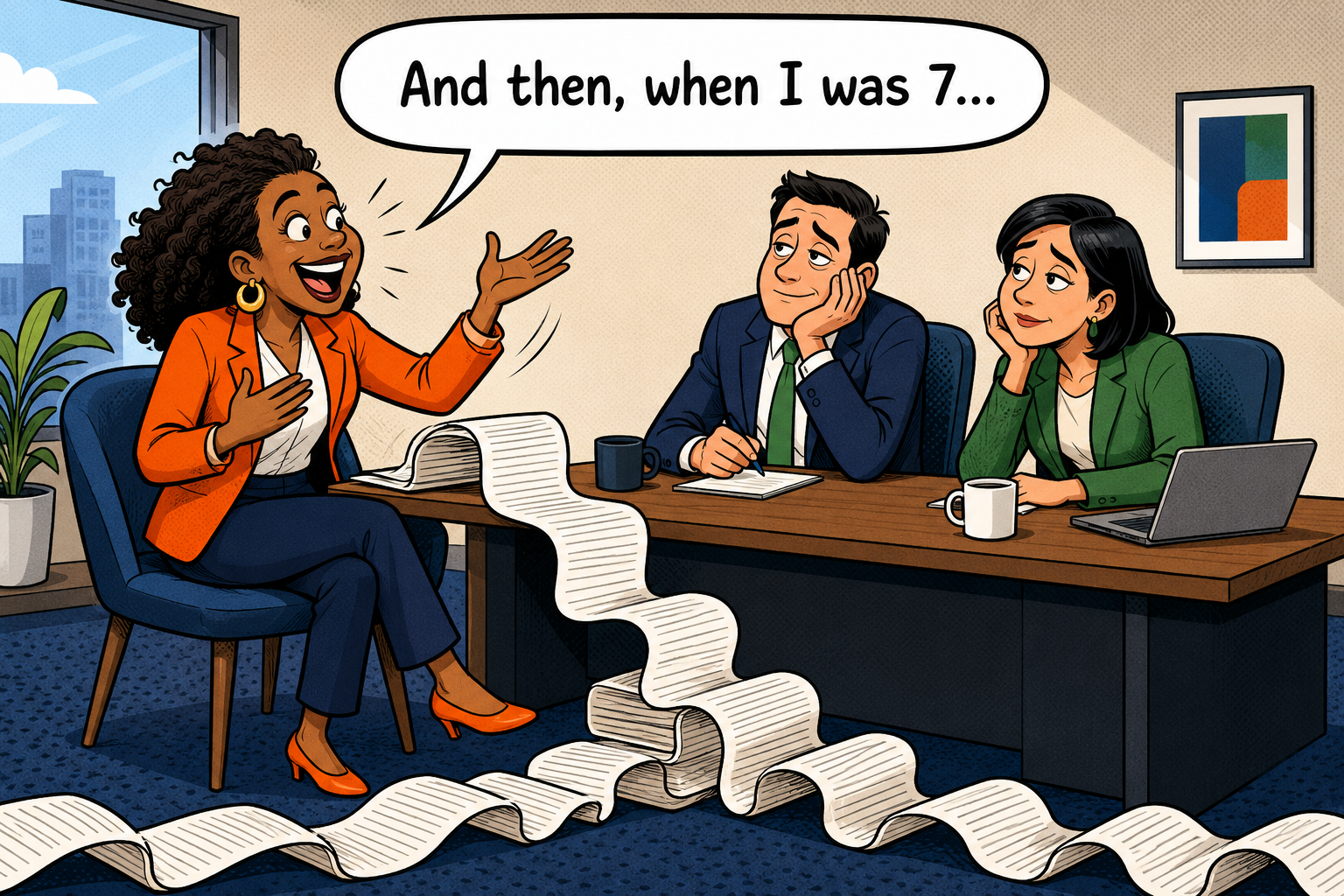
Cartoon of a candidate telling an extremely long life story during an interview
01

“Tell me about yourself.”

“And then, when I was 7…”

Takeaway: Give a focused 60–90 second professional story: present role, relevant strengths, and why you are interested.

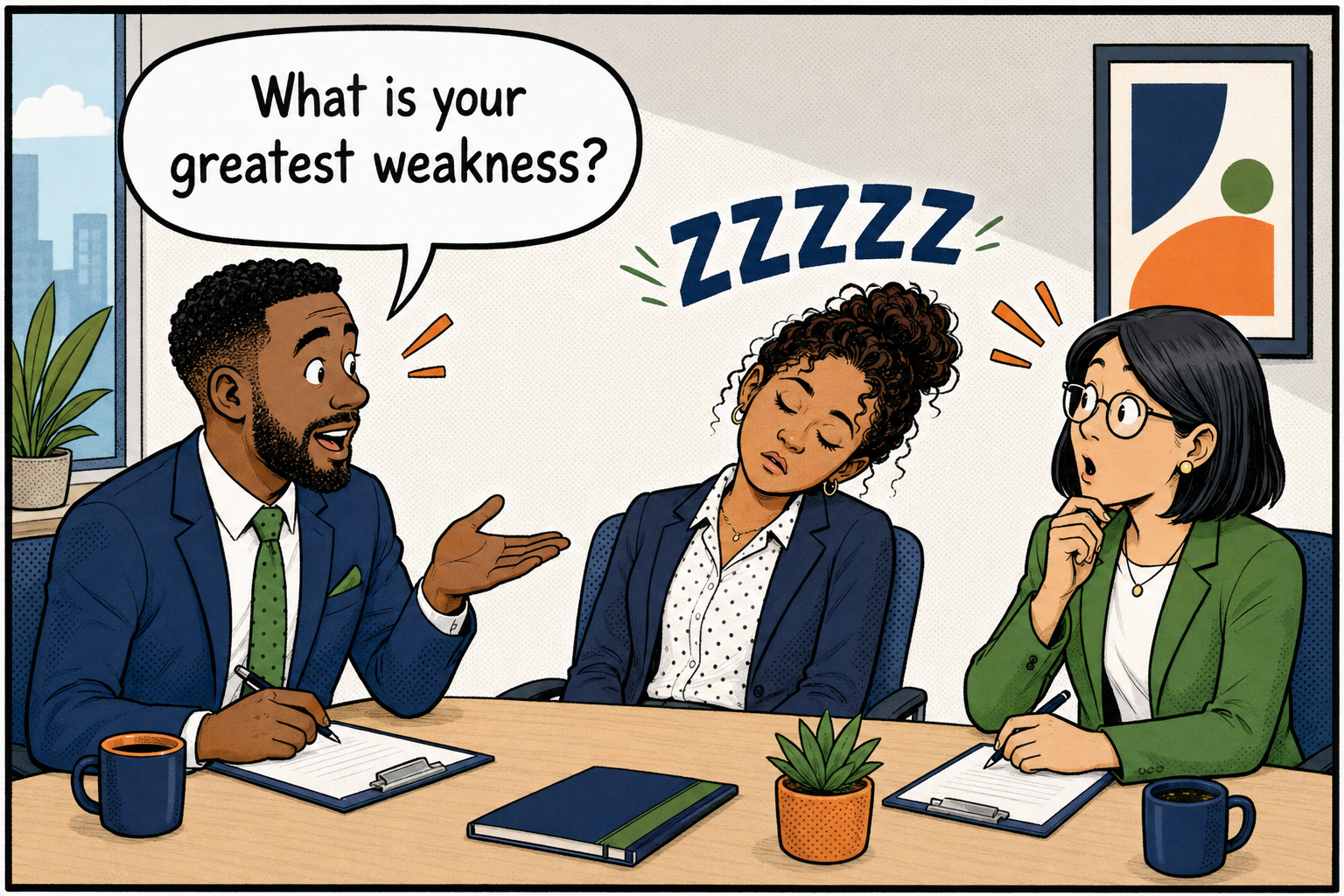
Cartoon of a candidate sleeping when asked about their greatest weakness
02

“What is your greatest weakness?”

Sometimes the evidence speaks for itself.

Takeaway: Choose a real, manageable weakness and show the concrete steps you are taking to improve it.

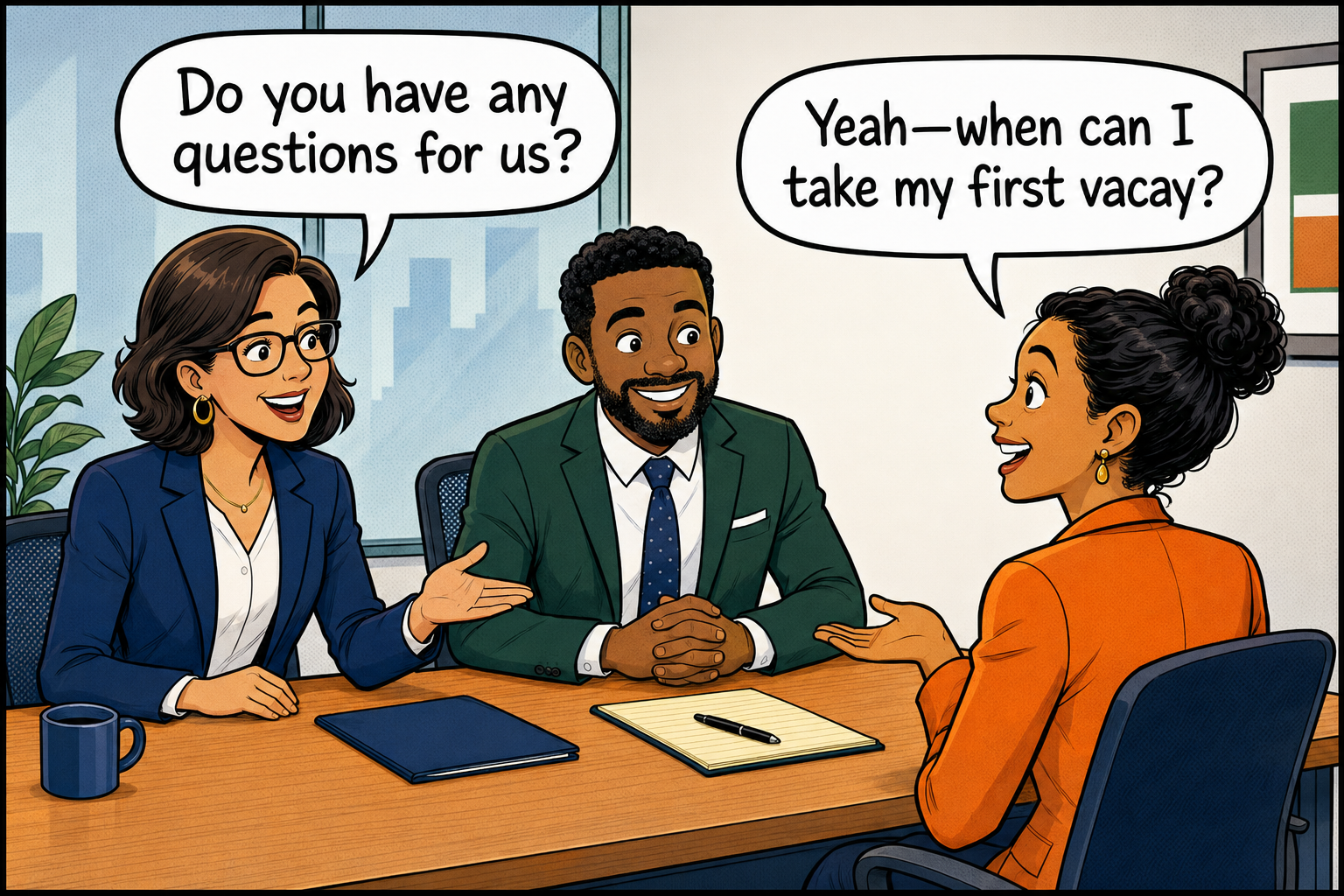
Cartoon of a candidate asking when they can take their first vacation
03

“Do you have any questions for us?”

Keep it real—but do not lead with vacation.

Takeaway: First ask about priorities, success, the team, and next steps. Discuss pay and benefits professionally at the appropriate stage.

Working together for opportunity

Event Partners & Resources

Use these public organization links and main business numbers to learn more. Individual staff contact information is not published.

Host and presenting organization

Florin Square Community Development Corporation

916-215-1831
Presenting workforce partner

Sacramento Employment and Training Agency

seta.net
Presenting government partner

State of California

ca.gov

Questions or partnership inquiries?

Contact Aaron Boyce

Florin Square Community Development Corporation